





















A casino slot meter can refer to several very different things: an accounting meter built into a gaming device, a progressive-jackpot display showing the current prize value, or a third-party website or tool that claims to monitor slot activity. Those distinctions matter because displaying information about a game is not the same as predicting its next result.
For players researching online slots, the safer approach is to separate measurable information from prediction claims. A legitimate meter may display credits, wagers, jackpot values, game information, or historical statistics. It should not automatically be interpreted as evidence that a particular slot is “hot,” “due,” or more likely to pay on the next spin.
This article explains what slot meters can legitimately track, how random-number-generated slots determine results, how RTP and volatility differ from live prediction signals, and how to evaluate a slot-monitoring service before relying on its claims.
Quick Answer: Can a Casino Slot Meter Predict the Next Spin?
For an RNG-based slot operating as designed, a public meter reading should not be treated as a reliable predictor of the next random outcome.
Technical standards used in regulated gaming markets require random-number-generated outcomes to be unpredictable. The UK Gambling Commission's Remote Gambling and Software Technical Standards, for example, require RNG output to be acceptably random and describe software RNG results as being computationally infeasible to predict without complete knowledge of the algorithm and seed. The same standard prohibits adaptive behaviour that changes probabilities during normal play simply because of previous results.
Therefore, a meter can display information without possessing a legitimate way to know what the next RNG outcome will be. This distinction is the foundation for evaluating any slot monitoring casino tool.
What Is a Casino Slot Meter?
The phrase can describe at least three different systems.
1. Gaming-device accounting meters
Traditional gaming devices can maintain internal accounting information such as money wagered, credits available, amounts paid, and jackpot-related records. Gaming Laboratories International standards describe electronic metering used by gaming devices for accounting purposes. These meters are operational records; they are not presented as systems for forecasting future random outcomes.
2. Progressive jackpot meters
A progressive slot may display the current value of its jackpot. This is a genuine type of meter, but it measures the prize amount, not necessarily the probability that the jackpot will be triggered on the next spin. GLI's progressive-jackpot standard describes jackpot displays used to communicate current jackpot payoff amounts.
3. Third-party slot monitoring tools
Some websites and applications use terms such as slot meter, scatter meter, jackpot monitor, win-rate monitor, hot-slot tracker, or slot monitoring tool. These are not all the same product.
A third-party dashboard might simply organize publicly available game information. Another might claim to calculate a “signal” or percentage for when to play. The presence of a percentage, arrow, heat indicator, or progress bar does not by itself establish that the tool has access to a game's certified RNG or that the number represents the probability of the next outcome.
What Can a Legitimate Slot Meter Track?
Different types of meters can display useful information without predicting results.
| Meter or information source | What it may show | Predicts the next RNG result? |
|---|---|---|
| Credit meter | Current playable credit balance | No |
| Accounting meter | Amounts wagered or paid | No |
| Progressive jackpot display | Current jackpot amount | Not by itself |
| Published RTP | Theoretical long-run return | No |
| Game history | Previous results | No |
| Session tracker | A player's own deposits, wagers, wins or losses | No |
| Provider catalogue | Game title, provider and published specifications | No |
| Third-party “win signal” | Proprietary score or estimate | Must be independently verified |
The safest question is not “Is the meter high?” It is: What exactly is this number measuring, and where does the underlying data come from? A percentage without a defined methodology is difficult to evaluate.
Why a Slot Meter Cannot Make an RNG Result “Due”
Random slots are built around probabilities rather than memory of a player's recent session. For properly implemented random machines, previous wins and losses do not make a future win automatically more likely simply because a losing streak has occurred.
The UK Gambling Commission explains that for random gaming machines, the chance of an outcome in the current game remains constant and is not changed by previous wins or losses.
Suppose a player sees seven losses in a row. It can feel intuitive that a win is becoming “due,” but a random process does not owe the player a balancing result on the next spin. Likewise, several wins in a row do not prove that a slot has entered a permanently “hot” state.
Historical results can describe what already happened. They are not automatically information about what the RNG will generate next.
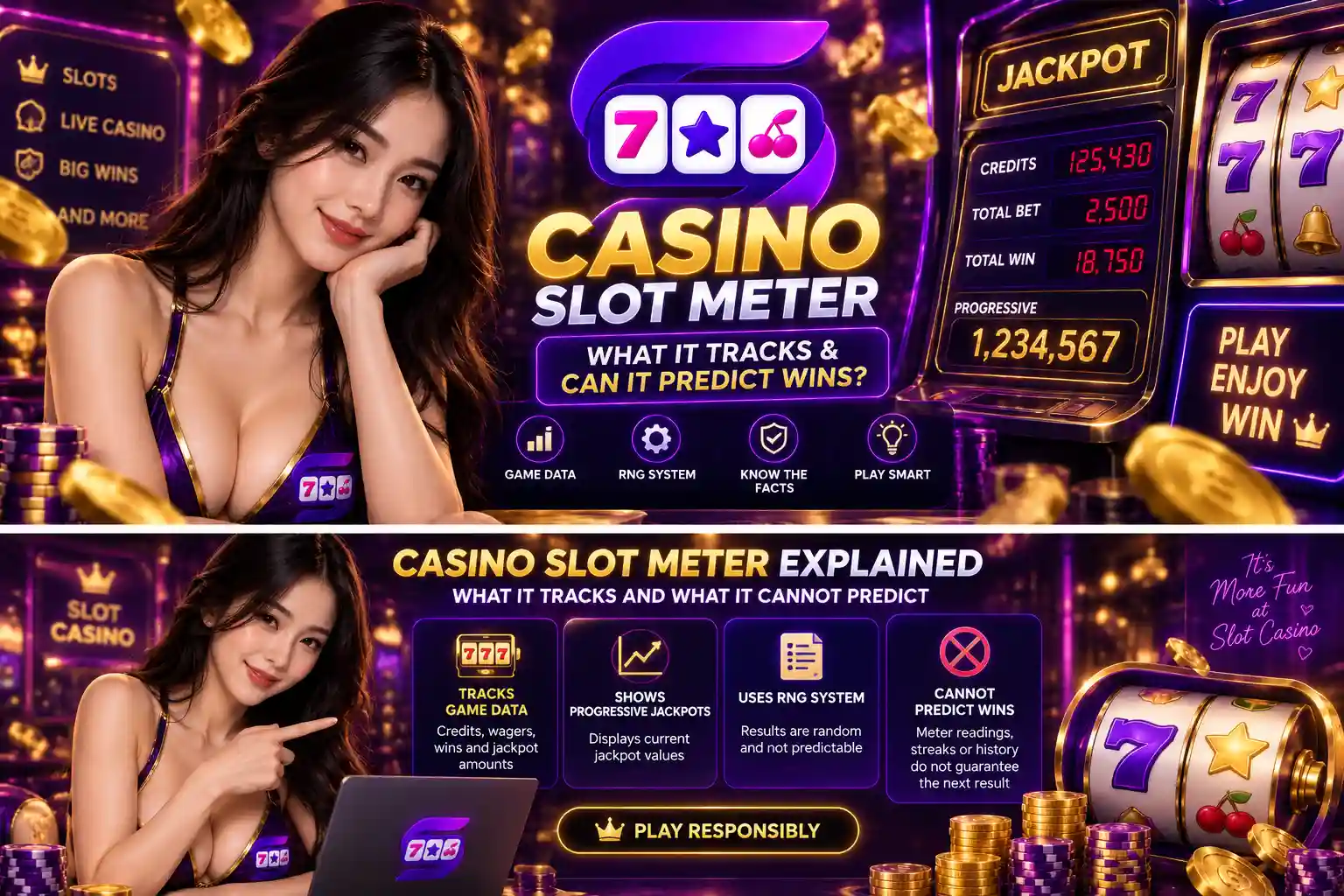
Casino Slot Meter vs Progressive Jackpot Meter
Progressive jackpots create one of the easiest sources of confusion. Imagine that a jackpot rises from ₱1,000,000 to ₱1,500,000. The jackpot meter clearly contains useful information: the prize has increased. But this does not automatically mean that the probability of winning the jackpot has increased by 50%.
Prize value and trigger probability are different variables. A progressive game's official rules might define special mechanics that affect eligibility or triggering behaviour. If so, those rules should be evaluated directly. Otherwise, the safer interpretation is that the meter tells you how much the progressive prize is currently worth—not when it will hit.
RTP Is Not a Live Slot Meter
Another common misunderstanding is treating RTP as though it were a live countdown toward a payout. RTP, or Return to Player, is a theoretical long-run percentage.
If a game has a published RTP of 96%, that does not mean every ₱100 session returns exactly ₱96, nor does it mean that after enough losses the next spin must restore the percentage.
For more detail, see SlotCasino.site's article on RTP and hit frequency. A useful distinction is:
- RTP: long-run theoretical return.
- Hit frequency: how frequently some type of paying outcome may occur.
- Volatility: how widely outcomes tend to vary in size and frequency.
- Meter reading: a displayed measurement whose meaning depends entirely on what the meter is designed to measure.
None of those numbers alone tells a player exactly what the next spin will be.
Does a High Meter Mean a Slot Is Hot?
Not necessarily. Terms such as “hot,” “cold,” “high signal,” and “low signal” can sound precise without having a standardized mathematical definition.
Before relying on such a label, check whether the tool explains what data is being collected, whether the data comes directly from the provider, what the displayed percentage mathematically represents, how often it is updated, whether it is historical or predictive, and whether the methodology has been independently tested.
A claim such as “90% meter means the slot is about to pay” requires much more evidence than the number displayed on a webpage. If a service cannot clearly define the calculation, the percentage should be treated as an interface indicator rather than a verified probability.
Slot Monitoring and Real Provider Data Are Not the Same Thing
A tool can legitimately receive game-catalogue information without receiving information that predicts future results. Catalogue data can include game title, software provider, category, thumbnail, published RTP, volatility where available, and release information.
SlotCasino.site itself uses catalogue data to help visitors explore free demo slots. Catalogue information can tell users what game is available, but SlotCasino.site does not interpret that data as a secret prediction of when the next winning spin will occur.
This is an important distinction between a game-information service and a win-prediction service.
What About “Scatter Meters”?
Scatter symbols are game mechanics. Their behaviour depends on the rules of the individual slot. Some games use scatters to trigger free spins, bonus rounds, multipliers, feature transitions, or prize events.
However, a third-party interface showing a “scatter percentage” does not by itself prove that the displayed number represents the probability of the next scatter combination.
To evaluate such a tool, look for documentation that explains:
- Numerator: What events are being counted?
- Denominator: What total number of events are they compared against?
- Time window: Is the figure historical, live, simulated, or estimated?
- Data source: Is the information from the provider, operator, user-submitted sessions, or an internal calculation?
- Probability claim: Does the tool describe past observations or forecast future RNG results?
What Should Players Check Instead?
Check the official paytable
The game information screen can explain winning combinations, wild symbols, scatter behaviour, bonus conditions, paylines or ways to win, maximum payouts, and feature rules.
Check published RTP information
RTP can help compare long-run mathematical configurations, although different versions of one game may use different RTP settings.
Understand volatility
Two games can have similar RTP figures and very different payout distributions.
Use demos to learn mechanics
A demo slot can help a player understand reels, symbols, bonus screens and interface behaviour without immediately committing money. Demo results still should not be treated as a forecast of future results.
Set a fixed budget
A clear budget is more controllable than trying to identify a “hot” machine from a recent pattern. SlotCasino.site's slot strategy resource focuses on RTP, volatility and bankroll decisions rather than guaranteed-win claims.
How to Evaluate a Casino Slot Meter Safely
- Identify the operator of the tool. Look for clear ownership, contact information and an explanation of what the service does.
- Read its methodology. “AI signal,” “live algorithm,” or “secret win rate” is not a methodology by itself.
- Look for the original data source. If a service claims direct provider data, determine whether documentation supports that relationship.
- Separate historical statistics from prediction. A dashboard might accurately record historical events while still being unable to forecast the next RNG result.
- Avoid credential-sharing tools. Do not give unknown monitoring applications casino passwords, OTP codes, payment credentials, identity documents, or remote access to a device.
- Treat guaranteed-win language as a warning sign. No responsible informational service should tell users that a meter can guarantee profit from a random game.
- Verify the casino separately. Use independent casino safety checks for domain, licence, payment and account-security verification.
A Better Way to Use Slot Data
Slot data is most useful when it answers descriptive questions: What provider made this game? What does the official paytable say? What RTP version is published? Is the game low, medium or high volatility? What triggers the bonus? Is a demo available? What is the current progressive jackpot amount?
A much harder claim is: What will happen on the next spin? For a properly designed random game, unpredictability is a fundamental technical objective.
Responsible Use of Slot-Monitoring Information
A meter should never become a reason to chase losses or increase stakes beyond a planned budget. Warning signs include thinking “the meter is high, so I need to increase my stake,” “I've lost ten times, so the next spin must win,” or “the jackpot is larger, so it must hit soon.”
Set limits before playing, treat gambling as paid entertainment rather than income, and stop when the planned limit has been reached. See SlotCasino.site's responsible gaming resources for budgeting, time limits and safer-play information.
Editorial Takeaway
A casino slot meter can be useful when it clearly measures something real: credits, historical activity, jackpot value, published game information or another defined metric. The problem begins when a measurement is presented as a prediction without enough evidence.
For RNG-based slots, a player should not assume that recent losses create a future win, a rising jackpot makes the next spin more likely to trigger it, a third-party percentage represents certified RNG probability, or a “hot” indicator guarantees a profitable session.
The safer approach is to verify what the meter measures, identify its data source, compare its claims with official game rules, and keep prediction claims separate from factual game information.
Frequently Asked Questions
What is a casino slot meter?
A casino slot meter is a broad term that can refer to an accounting display, progressive jackpot meter, game-information dashboard, or third-party slot-monitoring tool. Its meaning depends on what data the system actually measures.
Can a casino slot meter predict a winning spin?
A public meter should not be assumed to predict the next result of a properly implemented RNG-based slot. Technical standards for regulated RNG games are designed around random and unpredictable outcomes.
Does a high jackpot meter mean a jackpot is about to hit?
Not necessarily. A progressive jackpot meter primarily communicates the current prize amount. Whether jackpot probability changes depends on the game's documented rules; the amount alone does not prove that a win is due.
Is RTP the same as a slot meter?
No. RTP is a theoretical long-run return percentage. It is not a live countdown and does not guarantee the result of a particular session or spin.
Can previous slot results predict the next spin?
For random games operating as designed, previous wins or losses do not automatically change the probability of the next result simply because a streak has occurred.
Are slot-monitoring websites always fake?
No. A monitoring service can legitimately organize historical or public game data. The important question is whether it clearly explains its source and methodology and avoids unsupported claims that it can predict future RNG outcomes.
What information should I trust when comparing slots?
Start with the individual game's official rules and paytable, provider documentation, published RTP where available, clearly defined jackpot information, and independently verifiable technical information.
Sources & Further Reading
- UK Gambling Commission — RTS 7: Generation of random outcomes
- UK Gambling Commission — Return to Player
- Gaming Laboratories International — GLI-11 Gaming Devices
- Gaming Laboratories International — GLI-12 Progressive Gaming Devices
These references are used for general technical context. They are not statements that these standards govern every casino operator or jurisdiction.
Explore the Sponsored Casino Partner
Adults 21+ who choose to continue can review the partner's current terms, payment methods, game information and responsible-gaming controls before registering.